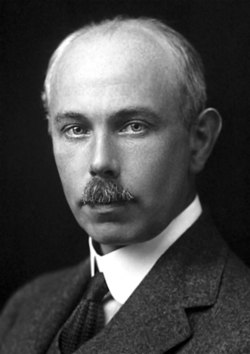
Photo credit: Unknown author — File:Francis William Aston.jpg (Wikimedia Commons) · Public domain
Francis William Aston
1877–1945 · United Kingdom · Born in the 1800s
Nobel Chemistry 1922
British physicist and chemist at Cambridge's Cavendish Laboratory who invented mass spectrography and discovered isotopes of stable elements.
Nobel Prize work
Built the first mass spectrograph, which separated ion beams by mass and revealed that many non-radioactive elements are mixtures of isotopes. From the measured masses he formulated the whole-number rule, showing that atomic weights are nearly integers and paving the way for nuclear binding-energy studies.
Fields
Related topics
Subatomic particles, isotopes, atomic number, mass number
Use proton, neutron and electron counts to identify atoms and ions. Isotopes share an atomic number but have different mass numbers.
High-resolution mass spectrometry
Accurate mass and resolving power distinguish ions that share the same nominal mass.