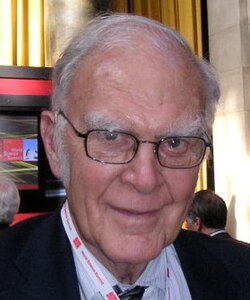
Photo credit: Markus Pössel — File:F. Sherwood Rowland.jpg (Wikimedia Commons) · CC BY-SA 3.0
F. Sherwood Rowland
1927–2012 · United States · 20th century
Nobel Chemistry 1995
American atmospheric chemist who traced the fate of CFCs and connected them to the destruction of stratospheric ozone.
Nobel Prize work
With Mario Molina, Rowland showed that chlorofluorocarbons survive long enough to reach the stratosphere, where ultraviolet light frees chlorine atoms that catalytically destroy ozone. Their photochemical model predicted the ozone hole and drove the Montreal Protocol banning CFCs — chemistry directly reshaping global policy.
Fields
Related topics
The ozone layer, the greenhouse effect
Stratospheric ozone shields life from ultraviolet radiation, while greenhouse gases absorb outgoing infrared radiation and warm the lower atmosphere. These distinct processes are explained through photochemistry, molecular vibrations and Earth’s radiative balance.
Photochemical reactions in the atmosphere
How sunlight initiates atmospheric reactions, creates and destroys ozone, and controls radical chemistry and pollutant lifetimes.