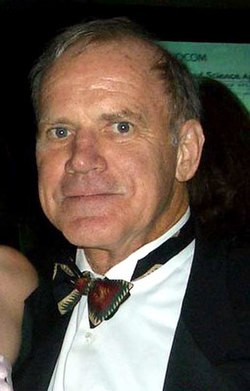
Photo credit: Dona Mapston — Wikimedia Commons · CC BY-SA 3.0
Kary B. Mullis
1944–2019 · United States · Contemporary
Nobel Chemistry 1993
American biochemist who invented the polymerase chain reaction at Cetus Corporation; PCR became the indispensable tool for copying DNA and earned him the 1993 Nobel Prize.
Nobel Prize work
For the invention of the polymerase chain reaction (PCR): conceived in 1983, it uses two primers and repeated cycles of heating and cooling to let a DNA polymerase copy a chosen segment exponentially, turning a single molecule into billions — and transforming genetics, medicine and forensics.
Fields
Related topics
DNA and RNA structure
DNA stores information in a paired double helix; RNA shares the nucleotide backbone but often forms diverse single-stranded folds.
Replication, transcription, translation
Cells copy genetic material, transcribe selected DNA segments into RNA, and translate messenger RNA into polypeptides.