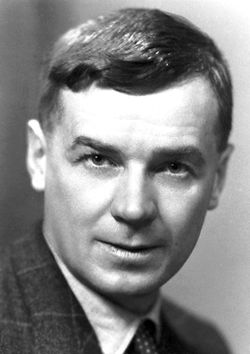
Photo credit: Unknown author — Wikimedia Commons · Public domain
Richard L. M. Synge
1914–1994 · United Kingdom · 20th century
Nobel Chemistry 1952
British biochemist who, with Archer Martin, invented partition chromatography; they shared the 1952 Nobel Prize for a technique that revolutionized the separation and analysis of mixtures.
Nobel Prize work
With Archer Martin he invented partition chromatography (1941–44), in which solutes distribute between two liquid phases; their paper and liquid chromatography separated amino acids with unprecedented ease, leading directly to the sequencing of proteins — and they foresaw gas chromatography.
Fields
Related topics
Amino acids, peptides, protein structure
Amino acids join through peptide bonds into chains that fold into proteins; four levels of structure explain how sequence determines shape and function.
Gas chromatography (GC), high-performance liquid chromatography (HPLC)
Chromatography separates components because they partition differently between mobile and stationary phases.